
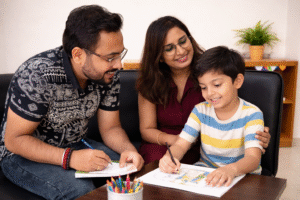
Summer breaks are often envisioned as carefree, joyful days—but for many working parents, they present a significant challenge. The transition from structured school routines to long, unplanned days during summer holidays can feel overwhelming. Between work commitments, handling childcare, and the constant question of “How do I keep my child occupied during summer vacation?” this period can quickly become stressful.
Most of us are aware that for balanced child development, unstructured time is essential for creativity and emotional growth in children. Yet, in today’s fast-paced world, when the logistics get tough, many parents find themselves relying on summer camps or increased screen time to fill the gap. While these can be helpful in moderation, excessive device use has been linked to reduced attention span and lower social interaction in children. The struggle to balance professional deadlines with meaningful parenting isn’t just a scheduling conflict—it’s a modern-day challenge for working parents.
So what are the real challenges parents face?
-
- Balancing demanding work schedules with childcare during summer holidays
-
- Feeling guilty about not spending “sufficient” time with children
-
- Excessive reliance on digital devices and screen time for kids
-
- Absence of organized but adaptable routines at home during school breaks
But here’s the change in perspective—summer holidays are not about doing more; they are about being more present, even in small ways.
Here are some simple, practical ways to make it work:

Establish micro-routines: A daily 20-minute practice—sharing breakfast in the morning, taking walks in the evening, or having bedtime conversations—can greatly support emotional bonding and child development.
Involve children in everyday activities: Cooking, grocery planning, or tidying up the home can become fun bonding activities while also teaching essential life skills to children.

Schedule “anchor days”: Pick 1–2 days a week for focused family time, even if it’s just a movie night or a trip to the park during summer vacation.
Promote solo play: Feeling bored isn’t negative—it frequently sparks imagination, creativity, and independent thinking in kids.
Restrict, don’t remove screens: Establish specific, achievable limits instead of outright prohibitions to maintain a healthy balance with screen time.
What’s important to remember is that children don’t measure time in hours—they measure it in connection.
When children return to school after a well-lived summer break, the difference shows. They come back more relaxed, more expressive, and often more confident. They carry stories—not just of places they went, but of moments they shared. That’s really what summer holidays are about. Not perfection, but connection.
And as a family, you carry something back too—a slightly stronger connection, built not through big plans, but through small, consistent presence.
That’s really what summer holidays are about. Not perfection, but connection.